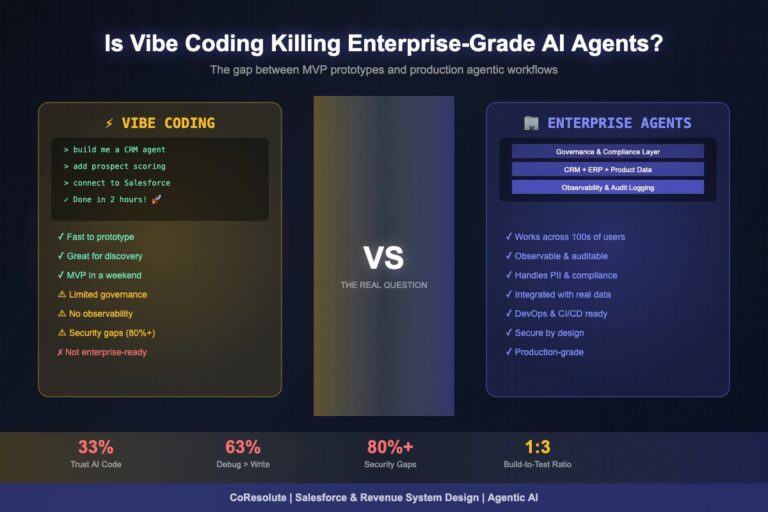
Moving from vibe coding to enterprise production means taking AI-assisted prototypes and putting them behind a harness: the layer of permissions, tools, data access, tests, and human approvals that lets a model do real work without becoming shadow IT. You do that in order. Define the terms. Map the stack you already have. Choose a harness that fits that stack. Get the team working in the open (Slack is one practical surface). Only then promote anything that touches customers or revenue data.
I have watched mid-market teams skip straight from a weekend demo to “can we put this on Salesforce.” The demo was never the hard part. The hard part is shared context, shared rules, and shared ownership. For the definition of enterprise vibe coding and when it is safe, read Enterprise Vibe Coding: When AI Code Is Production-Safe. This guide is the step-by-step path after that thesis.
Step 1: Speak the same language (a short glossary)
If your leadership team uses “model,” “agent,” “platform,” and “harness” as synonyms, you will buy the wrong thing. Start with plain definitions. Thoughtworks describes an AI agent harness as the software environment around a model that gives the agent context, tools, rules, state, and feedback (Thoughtworks). I have argued the same point on this site: the model is rented; the harness is what you own (What Is an AI Harness?).
| Term | Plain meaning |
|---|---|
| Model | The large language model (or smaller specialist model) that predicts text and tool calls. You call it through an API or a hosted runtime. |
| Frontier model | A top-tier, usually closed, vendor model optimized for hard reasoning and broad tasks. Strong, and often the most expensive option per token. |
| Open-weight / local model | A model whose weights you can run yourself (or have a vendor host for you). Useful when data residency, cost, or offline constraints matter. |
| Small model | A lighter model used for routine classification, drafting, or routing. Often the default for high-volume work before you escalate to a frontier model. |
| Harness | The environment around the model: instructions, tools, memory/state, permissions, feedback (tests, logs), and human approval gates. |
| Studio | A vendor UI for configuring prompts, models, agents, or automations without building a full custom app. A studio is a build surface, not the full production control plane by itself. |
| Agent | The model working through a harness to pursue a goal (read files, call tools, update records, ask for approval). |
| Cloud | Model or harness hosted by a provider over the internet, usually with enterprise IAM and regional controls. |
| On-prem | Software you run in your own data center or private cloud, under your network and physical controls. |
| Local | Running on a laptop or workstation (or a small team machine). Fine for discovery. Rarely enough for shared production access, audit, or uptime. |
Amazon Bedrock is one enterprise example of the cloud path: a managed service that gives access to foundation models from multiple providers so you can build and scale generative AI applications (AWS). AWS also documents an AgentCore harness as the managed orchestration layer around model, tools, memory, identity, and observability (AWS). You do not need Bedrock to have a harness. You do need to know whether you are buying a model endpoint, a studio, or a full harness.
Step 2: Understand your current stack before you pick anything
Do not start with a vendor bake-off. Start with an inventory.
- Where does revenue work already live? For most of our clients that is Salesforce at the center, with HubSpot, Marketo, Pardot, Dynamics, or a warehouse around it.
- Who owns permissions today? If you cannot answer who can edit Opportunity or Case, you are not ready to let an agent write to those objects.
- What is the data quality story? Duplicate accounts, stale stages, and wrong contact roles do not get smarter when an agent reads them. They get louder. Clean, deduplicate, enrich, and route data across CRM, MAP, and related systems before AI consumes it. That work is not a harness. It is often the prerequisite for one.
- Where are people already experimenting? Shadow AI in personal ChatGPT accounts is a signal, not a strategy. Note the tools, the use cases, and the data leaving the building.
- What release path exists? Source control, sandboxes, change sets, DevOps Center, or “someone with admin clicks Deploy.” Your harness has to fit the release culture you actually have.
Write the answers in one page. That page beats a 40-slide AI strategy deck.
Step 3: How to pick a harness
A harness decision is an operating-model decision. StackAI’s 2026 platform guide puts it bluntly: an LLM API is not an enterprise platform, and buyers should check connectors, agentic workflows, model flexibility, runtime governance, evaluation, cost attribution, and deployment fit (StackAI). Use a criteria table, score vendors against your inventory from Step 2, and run a short proof of value on one real workflow.
Selection criteria (score each 1 to 5)
| Criterion | What to ask |
|---|---|
| Fit to existing systems | Does it connect to Salesforce, your MAP, warehouse, Slack, and identity provider without a science project? |
| Model flexibility | Can you route across frontier, open-weight, and small models, including options like Amazon Bedrock when your cloud standard requires it? (AWS Bedrock) |
| Permissions and approvals | Can you enforce least privilege and human sign-off before customer-facing or irreversible actions? |
| Audit and observability | Can security ask what the AI did last week and get a real answer (prompts, tool calls, data access)? |
| Evaluation | Can you test before release and monitor quality after release? |
| Team sharing | Can more than one person use the same agents, context, and outputs, or does knowledge die in one chat history? |
| Cost visibility | Can you attribute spend by team, agent, and workflow before finance finds out the hard way? |
| Deployment posture | Cloud, hybrid, on-prem, or local: which options match your residency and security rules? |
| Domain fit | Is this a general coding harness, a platform harness inside Salesforce/Agentforce, or a GTM-specific agent layer? |
Enterprise options worth knowing (examples, not a ranked list)
Hyperscaler model layer (example: Amazon Bedrock). Buy managed access to multiple foundation models inside your AWS control plane (AWS). Pair it with a harness (including AWS’s own AgentCore harness documentation) if you need tools, memory, identity, and observability around those models (AWS).
Platform harness inside systems you already own. Salesforce Agentforce and similar platform agent layers sit next to your CRM permissions and data. See our Salesforce services and Agentforce and agentic workflows pages for how we approach that work.
Domain GTM agent / harness (example: Swan). Swan describes itself as an AI go-to-market agent: plain-language instructions for research, enrichment, CRM work, outreach, and triggers, with integrations such as HubSpot, Salesforce, and Slack, plus roles, approvals, and run history (Swan docs; Swan). Treat it as a GTM workflow harness, not as a general software-engineering IDE replacement.
Build your own. Possible. Expensive. Most mid-market teams are better buying a harness and spending engineering time on data contracts and approvals.
Pick one primary harness for the first production use case. Multi-harness sprawl recreates the frankenstack problem you already have in RevOps.
Step 4: Use Slack so the team can work together
Single-player AI leaves nothing behind when someone goes on vacation. Multi-player AI needs a shared place to prompt, review, and approve.
Slack documents Slack Code as the way agents and people build with AI together in Slack. A supported agent can create a temporary code channel from a channel or DM. Teammates join, exchange messages, share files, prompt the agent, review artifacts (including code diffs, canvases, HTML previews, and shared files), comment on code, and sign off in one place. Active code channels appear in a sidebar section, and inactive ones can leave the sidebar after seven days of inactivity. Slack notes the feature is rolling out gradually and works with specific Marketplace agents (examples Slack lists include Claude, GitHub Copilot, Devin, and others) (Slack Help).
Practical rules for a RevOps or GTM team:
- Install only approved Marketplace agents. Slack states agents used in code channels must come from the Slack Marketplace and follow Slack’s Acceptable Use Policy (Slack Help).
- Start code channels from a real work request (“draft the lead-routing test plan,” “review this Flow”), not from idle chatting.
- Keep production credentials out of the channel. Share specs, sample (non-sensitive) payloads, and links to tickets.
- Use the channel to force human review before anything deploys. The point is shared judgment, not faster rubber-stamping.
Slack also documents working with AI agents more broadly inside Slack (asking agents questions, getting help in channels) (Slack Help). Use that for day-to-day assistance. Use Slack Code when the work needs a contained, multiplayer build session.
This is how multiple users get started on shared AI work without each person inventing a private prompt library. It is not a substitute for a harness’s permission model. It is how humans stay in the loop while the harness does the work.
Step 5: Promote only what survives review
When the glossary is shared, the stack is mapped, the harness is chosen, and the team can work in the open, apply the production bar from the companion article: security, testing, governance, DevOps, and named ownership (Enterprise vibe coding article). Prototype in local or scratch environments. Harden in the harness. Ship through your normal release path.
PCG’s Vibe2Prod framing is useful here even if you never adopt their brand name: treat the vibe-coded artifact as a baseline for engineering, not as the production binary (PCG).
Where coResolute fits
coResolute is a RevOps services firm that designs, builds and runs revenue systems. We help mid-market teams stabilize Salesforce and GTM stacks, then put agentic work on top only when the data and rules can hold it. If you want a plain read of readiness before you buy another AI seat, start with a free CRM Health Check. Contact us. No invoice. No sales pitch.
For implementation and agentic delivery paths, see Salesforce services and Agentforce and agentic workflows.
The takeaway.
Vibe coding gets you a demo. A harness, clean data, shared team workflow, and a real release path get you production. Learn the words, map the stack, pick the harness on purpose, work in the open, then promote what you can defend.
FAQ
What is the difference between a model and a harness?
The model generates predictions. The harness surrounds it with tools, context, permissions, feedback, and approvals so those predictions can become reliable work (Thoughtworks).
Do I need Amazon Bedrock to go to production?
No. Bedrock is one enterprise way to access foundation models under AWS controls (AWS). You still need a harness and a release process around whatever model layer you choose.
What is Swan in this context?
Swan is an AI go-to-market agent for research, enrichment, CRM work, outreach, and triggered workflows, with team permissions and approvals (Swan docs). It is a domain GTM harness-style product, not a general IDE.
How does Slack help a team share AI work?
Slack Code lets a supported agent open a temporary code channel where teammates prompt together, share files, review artifacts, and approve outputs in one place (Slack Help).
What should we do before buying any AI tool?
Inventory your systems, permissions, data quality, shadow AI use, and release path. Then score harness options against that inventory. If the CRM is a mess, fix or orchestrate the data first.