
Is Vibe Coding Killing the Promise of Enterprise-Grade AI Agents?
Vibe coding is not killing enterprise AI agents—but trying to deploy vibe-coded prototypes as enterprise systems is.
Everyone is excited about spinning up AI agents. You can stand something up in a weekend now: prospect research, email drafting, support responses, internal copilots. Tools like Cursor, GitHub Copilot, and Claude make it feel like a superpower.
But when you start looking at what it takes to operationalize an AI agent inside a company—inside real workflows, touching real customer data, serving real users—the picture changes quickly.
The State of AI Code in 2025
The data on AI-generated code should give every enterprise leader pause before rushing a vibe-coded agent into production. These aren’t reasons to avoid AI—they’re reasons to build it properly.
What the Data Says About Vibe Coding in Production
Before debating the philosophy, it’s worth grounding the conversation in what’s actually happening with AI-generated code in enterprise environments today:
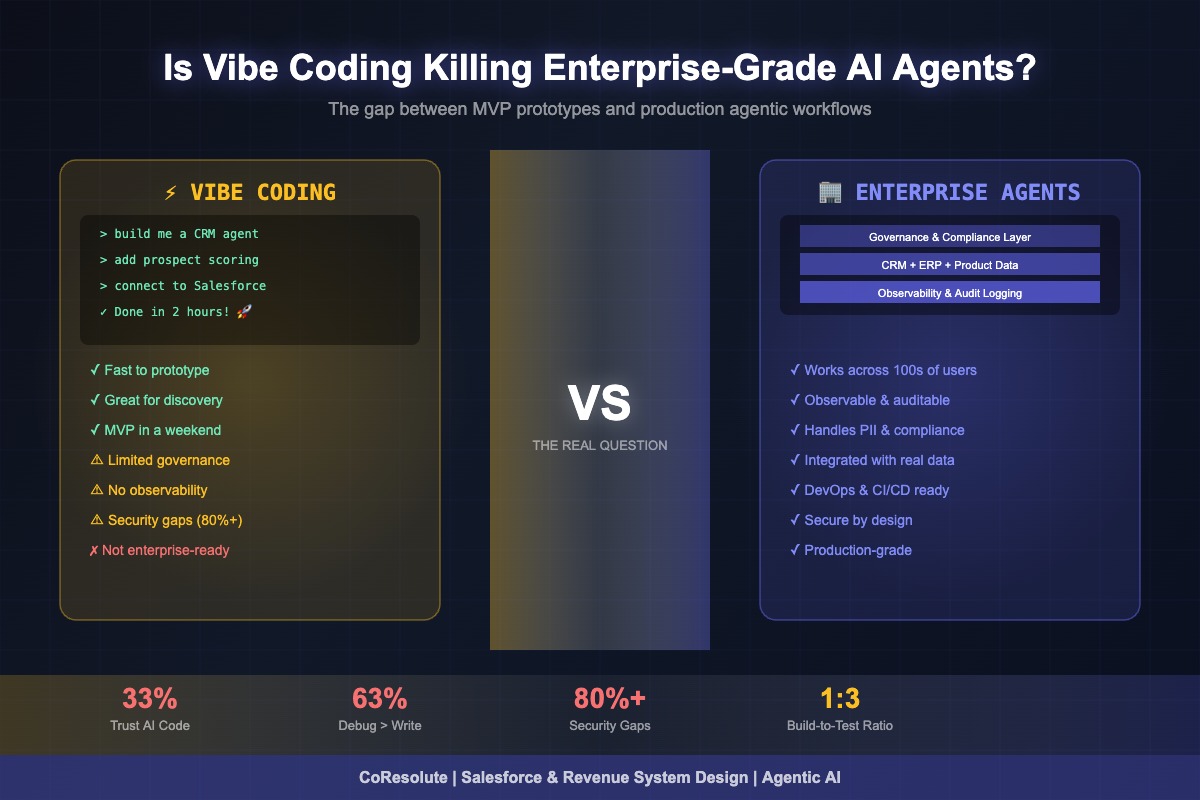
Only 33% of developers trust AI-generated code—down from approximately 43% a year ago. Trust is declining, not growing, as teams get more experience with AI outputs in production.
63% of developers say they spend more time debugging AI-generated code than they would spend writing it themselves. The speed gains on the front end are frequently erased on the back end.
More than 80% of AI-generated code contains security vulnerabilities when examined by independent security audits. In an enterprise context handling customer PII, financial data, or product records, this is not an acceptable baseline.
This is not an argument against using AI in software development. It is an argument for understanding what vibe coding is—and what it is not.
Vibe Coding vs. Enterprise Agentic AI: The Core Difference
The confusion in the market stems from treating these two things as if they exist on the same spectrum. They do not.
Vibe-coded agents are built by individuals or small teams. They solve a narrow, well-defined problem, often outside core systems. They have limited integrations, minimal governance, and no observability. They are excellent for proving an idea. They are not built to scale.
Enterprise agentic AI workflows are fundamentally different in kind, not just in degree. They sit inside live business workflows. They are triggered by real events—a new lead in Salesforce, a service ticket in ServiceNow, an order change in an ERP. They touch real customer and product data. They must work reliably across hundreds of users, dozens of edge cases, and changing business rules in a way that is observable, secure, auditable, and repeatable.
One is a prototype. The other is infrastructure.
7 Patterns That Appear in Every Enterprise Agent Build
After building operational agentic workflows for enterprise clients over the past several years, the same friction points appear in every engagement—regardless of industry, platform, or team size:
1. Every environment is different. Governance requirements, DevOps maturity, platform sprawl, and data quality vary enormously across organizations. None of that complexity disappears because you have better prompts. The agent still has to operate inside the environment that exists.
2. Connecting agents cleanly to live data is where time goes. Getting an agent running is easy. Connecting it to customer, product, and service data—without polluting outputs or creating downstream data integrity issues—is where the real engineering work lives.
3. The build-to-test ratio is approximately 1:3. For every one week of building an enterprise agent, expect three weeks of testing across all real-world execution paths. Edge cases multiply quickly when real users with unpredictable inputs hit a live workflow.
4. Governance surfaces immediately. Toxicity filtering, PII handling, hallucination rates, auditability, and reporting requirements all emerge the moment you move from a demo to a production context. You need to be able to explain what the agent did and why—to your team, your compliance function, and your customers.
5. DevOps is rarely ready for agent deployments. Moving agent configurations across development, staging, and production environments is still clunky and largely manual at most organizations. This slows deployment velocity and increases deployment risk.
6. You will build workarounds for A/B testing, routing, and flow logic. Most enterprise platforms do not yet have mature native tooling for agent-specific testing and routing. Expect to engineer these solutions yourself or use emerging third-party tooling.
7. Observability is non-negotiable. Without strong logging, tracing, and monitoring on your agent’s behavior, you are guessing. In a production environment with real business consequences, guessing is not a strategy.
The Mistake: Retrofitting Vibe Code Into Enterprise Workflows
The most common and costly mistake in enterprise AI adoption right now is trying to take a vibe-coded prototype—something built over a weekend to prove a concept—and retrofit it into a production enterprise workflow.
That almost never works.
The prototype was built under different assumptions: a single user, controlled inputs, no compliance requirements, no integration complexity, no observability needs. Patching enterprise requirements onto that foundation is like retrofitting a load-bearing wall into a building that was designed without one. You can do it, but it costs far more than building it right from the start.
A Better Framework: Vibe Coding as Discovery, Not Deployment
This is not an argument against vibe coding. It is one of the fastest ways to explore ideas, test hypotheses, and stress-test workflows that has ever existed. Use it aggressively—but use it correctly.
The right framework treats vibe coding as a discovery phase, not a deployment phase:
Step 1: Use vibe coding to learn. Build the agent quickly. Find out what it should do, where it breaks, what data it needs, and which edge cases matter. Get a real feel for the scope of the problem before investing in a production build.
Step 2: Step back and define requirements properly. Turn the lessons from discovery into real engineering requirements: workflow definitions, data dependencies, integration points, governance rules, and observability requirements.
Step 3: Rebuild inside your systems with the right skills and architecture. This means proper developer involvement, enterprise-grade architecture decisions, governance frameworks, and the observability infrastructure to run the agent reliably in production. Platforms like Salesforce Agentforce, ServiceNow AI Agents, and Microsoft Copilot Studio provide enterprise scaffolding that dramatically reduces the governance and integration burden.
Vibe coding is the fastest way to learn. Enterprise architecture is the only way to scale.
What Enterprise Leaders Should Ask Before Deploying an AI Agent
Before any AI agent moves from prototype to production, every enterprise leader should be able to answer these questions:
Can you explain what the agent did and why, for any individual execution? If not, you do not have observability—and you will not be able to debug, audit, or defend the agent’s decisions when something goes wrong.
How does the agent handle PII, sensitive customer data, and compliance requirements? The answer needs to exist before deployment, not after a data incident.
What happens when the agent encounters an input or scenario it was not designed for? Edge case handling, fallback logic, and escalation paths are not optional in enterprise workflows.
How will the agent be tested, updated, and monitored after it goes live? A production agent is not a finished product—it is an ongoing operational commitment.
Does your DevOps pipeline support agent deployments across environments? If not, your deployment risk is higher than it needs to be, and your velocity will be limited.
Frequently Asked Questions About Vibe Coding and Enterprise AI Agents
What is vibe coding? Vibe coding refers to the practice of using AI-assisted development tools—such as Cursor, GitHub Copilot, or Claude—to rapidly generate functional software or AI agents through natural language prompts, often without deep manual code review. It prioritizes speed and ideation over production readiness.
Can vibe-coded AI agents be used in enterprise environments? Not without significant re-engineering. Vibe-coded agents are excellent for prototyping and discovery but lack the governance, observability, security, and integration architecture required for enterprise production deployments. They should inform enterprise builds, not replace them.
What makes an AI agent “enterprise-grade”? An enterprise-grade AI agent operates reliably at scale across hundreds of users, integrates cleanly with live CRM, ERP, and service data, handles PII and compliance requirements, produces auditable logs of its decisions, and can be tested, deployed, and updated through a standard DevOps pipeline.
Why is governance a challenge for enterprise AI agents? Enterprise agents interact with sensitive customer data, make decisions with real business consequences, and must comply with industry regulations. Governance requires the ability to detect and filter toxic or harmful outputs, handle personally identifiable information, trace agent decisions for audit purposes, and report on agent behavior over time—none of which are built into vibe-coded prototypes by default.
What platforms support enterprise-grade agentic AI? Salesforce Agentforce, ServiceNow AI Agents, Microsoft Copilot Studio, and Google Vertex AI Agent Builder are among the leading platforms providing enterprise scaffolding for agentic workflows, including native governance, data integration, and observability features.
What is the right role for vibe coding in an enterprise AI strategy? Vibe coding belongs in the discovery and prototyping phase of enterprise AI development. Use it to explore what an agent should do, identify where workflows break, and define data requirements. Then use those insights to inform a proper enterprise build with the right architecture, governance, and operational infrastructure.
Book a Call
If you like what you see, we think you’re gonna love what you hear. Book a first consultation with us, and together we’ll figure out how to make your life a little better.

Have You Checked Your Web Chatbot Lately?
Your web chatbot is probably costing you more than it’s helping.
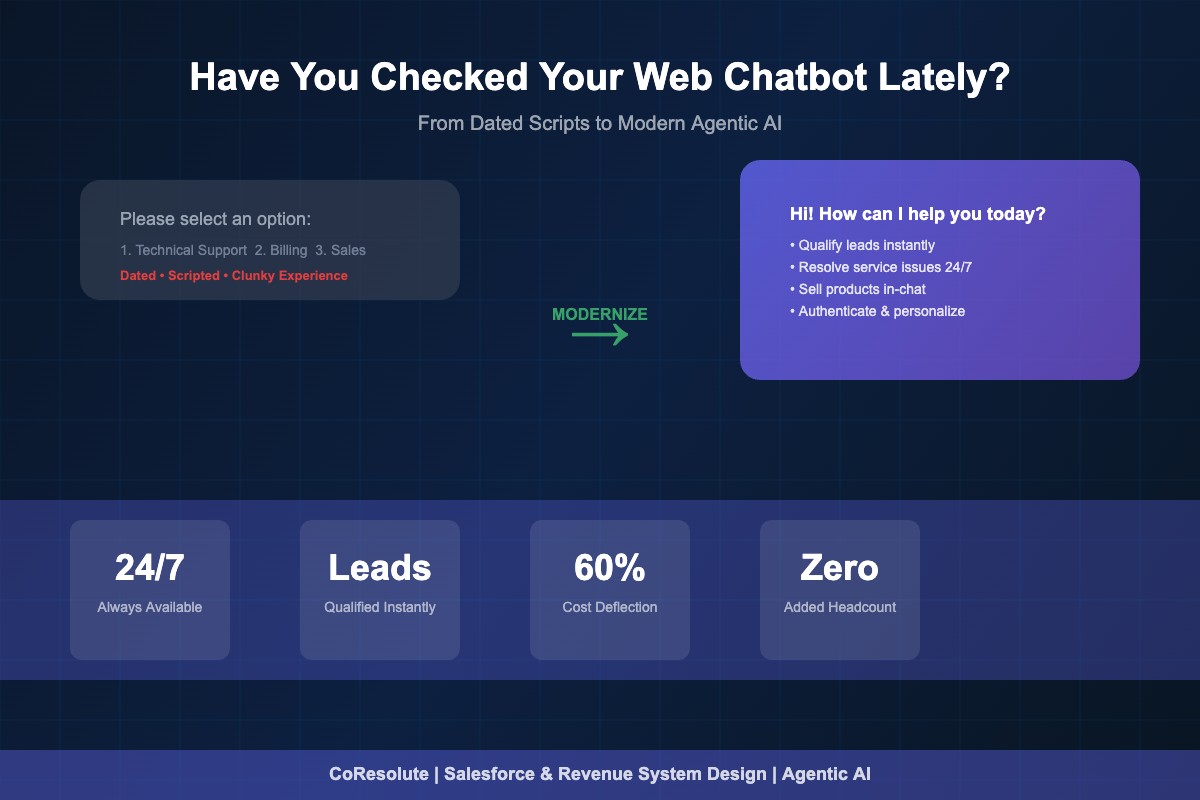
I just checked ten random websites to test a hypothesis. All ten were dated chatbots circa Covid. Scripted intros, ask for email quickly, force a choice from a picklist, clunky experience, and ultimately, a case is created that needs a human.
That’s crazy to me. I’m seeing all kinds of use cases for Agentic AI to build and automate something unproven. Risky.
Start With What’s Already There
A better place to start is modernizing the old web chat to a modern agentic experience. At this point, most customers or prospects expect it. Having something scripted and generic only invites disdain and a quick exit from the chat.
A better place to start is modernizing the old web chat to a modern agentic experience.
At this point, most customers or prospects expect it. Having something scripted and generic only invites disdain and a quick exit from the chat.
And now you can create a much more powerful and complete experience.
You can deflect a massive amount of questions from potential prospects, warm them up, and send qualified leads to reps.
You can deflect and resolve common service issues of current customers with active authentication in the chat.
You can actively sell e-commerce products in the chat.
You can activate more advanced resolution workflows like returns, pick-ups, order changes, and much more.
And much more.
So if you are feeling the heat from the BOD and your bosses to launch an AI project and are struggling, start with the chatbot.
There is an asymmetric return here with limited downside. The infrastructure exists. The use cases are proven. The user expectation is already there.
You’re not building something from scratch—you’re upgrading what’s already broken.
The modern agentic chatbot isn’t just a support tool. It’s a revenue engine, a lead qualifier, and a service resolver—all running 24/7 without adding headcount.
Want to discuss deeper? DM me.
Book a Call
If you like what you see, we think you’re gonna love what you hear. Book a first consultation with us, and together we’ll figure out how to make your life a little better.